Rtf 351c Introduction to 2d Animation Aet 325 Digital Production Art 2d
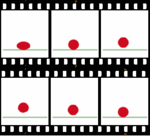
The bouncing ball animation (below) consists of these six frames, repeated indefinitely.

This animation moves at ten frames per second.
Animation is a method in which figures are manipulated to announced every bit moving images. In traditional animation, images are drawn or painted by hand on transparent celluloid sheets to be photographed and exhibited on movie. Today, nearly animations are made with figurer-generated imagery (CGI). Estimator animation can exist very detailed 3D animation, while 2D computer animation (which may have the look of traditional animation) can be used for stylistic reasons, depression bandwidth, or faster existent-time renderings. Other common animation methods utilize a stop motion technique to ii- and three-dimensional objects similar paper cutouts, puppets, or dirt figures.
An animated drawing is an animated film, usually a short moving picture, featuring an exaggerated visual style. The style takes inspiration from comic strips, often featuring anthropomorphic animals, superheroes, or the adventures of human protagonists (either children or adults). Especially with animals that class a natural predator/prey relationship (due east.k. cats and mice, coyotes and birds), the activeness often centers around trigger-happy pratfalls such as falls, collisions, and explosions that would be lethal in existent life.
The illusion of blitheness—as in motion pictures in general—has traditionally been attributed to persistence of vision and later to the phi phenomenon and/or beta move, but the exact neurological causes are still uncertain. The illusion of motion acquired past a rapid succession of images that minimally differ from each other, with unnoticeable interruptions, is a stroboscopic effect. While animators traditionally used to draw each role of the movements and changes of figures on transparent cels that could be moved over a divide background, reckoner animation is ordinarily based on programming paths between key frames to maneuver digitally created figures throughout a digitally created environment.
Analog mechanical animation media that rely on the rapid display of sequential images include the phénakisticope, zoetrope, flip book, praxinoscope, and film. Television and video are popular electronic animation media that originally were analog and now operate digitally. For brandish on computers, technology such equally the animated GIF and Wink blitheness were developed.
In addition to short films, feature films, idiot box series, blithe GIFs, and other media defended to the display of moving images, animation is too prevalent in video games, move graphics, user interfaces, and visual furnishings.[1]
The physical movement of image parts through elementary mechanics—for example moving images in magic lantern shows—can likewise be considered animation. The mechanical manipulation of three-dimensional puppets and objects to emulate living beings has a very long history in automata. Electronic automata were popularized past Disney as animatronics.
Etymology [edit]
The word "animation" stems from the Latin "animātiōn", stalk of "animātiō", pregnant "a bestowing of life".[2] The primary meaning of the English language word is "liveliness" and has been in use much longer than the meaning of "moving epitome medium".
History [edit]
Before cinematography [edit]

Nr. x in the reworked 2nd serial of Stampfer's stroboscopic discs published by Trentsensky & Vieweg in 1833.
Hundreds of years before the introduction of true animation, people all over the world enjoyed shows with moving figures that were created and manipulated manually in puppetry, automata, shadow play, and the magic lantern. The multi-media phantasmagoria shows that were very popular in European theatres from the tardily 18th century through the first half of the 19th century, featured lifelike projections of moving ghosts and other frightful imagery in motion.
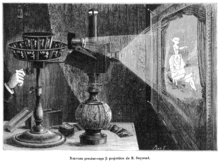
A projecting praxinoscope, from 1882, here shown superimposing an animated figure on a separately projected background scene
In 1833, the stroboscopic disc (better known as the phénakisticope) introduced the principle of modern animation with sequential images that were shown one by 1 in quick succession to course an optical illusion of motion pictures. Series of sequential images had occasionally been made over thousands of years, merely the stroboscopic disc provided the starting time method to represent such images in fluent motion and for the get-go fourth dimension had artists creating series with a proper systematic breakdown of movements. The stroboscopic blitheness principle was also applied in the zoetrope (1866), the flip volume (1868) and the praxinoscope (1877). A typical 19th-century animation contained about 12 images that were displayed as a continuous loop by spinning a device manually. The flip book frequently contained more pictures and had a beginning and end, but its animation would not last longer than a few seconds. The first to create much longer sequences seems to have been Charles-Émile Reynaud, who between 1892 and 1900 had much success with his 10- to xv-minute-long Pantomimes Lumineuses.
Silent era [edit]
When cinematography eventually broke through in 1895 subsequently animated pictures had been known for decades, the wonder of the realistic details in the new medium was seen as its biggest achievement. Blitheness on motion-picture show was not commercialized until a few years later by manufacturers of optical toys, with chromolithography film loops (often traced from live-activeness footage) for adjusted toy magic lanterns intended for kids to apply at abode. It would accept some more years before animation reached moving picture theaters.
Later on earlier experiments by movie pioneers J. Stuart Blackton, Arthur Melbourne-Cooper, Segundo de Chomón, and Edwin S. Porter (among others), Blackton's The Haunted Hotel (1907) was the outset huge stop motility success, baffling audiences by showing objects that apparently moved by themselves in full photographic particular, without signs of whatever known stage fox.

Émile Cohl's Fantasmagorie (1908) is the oldest known instance of what became known as traditional (manus-drawn) blitheness. Other great artistic and very influential short films were created by Ladislas Starevich with his puppet animations since 1910 and by Winsor McCay with detailed drawn animation in films such as Little Nemo (1911) and Gertie the Dinosaur (1914).
During the 1910s, the production of animated "cartoons" became an manufacture in the Usa.[3] Successful producer John Randolph Bray and animator Earl Hurd, patented the cel blitheness procedure that dominated the animation manufacture for the balance of the century.[4] [five] Felix the Cat, who debuted in 1919, became the first blithe superstar.
American golden historic period [edit]
In 1928, Steamboat Willie, featuring Mickey Mouse and Minnie Mouse, popularized picture with synchronized audio and put Walt Disney's studio at the forefront of the blitheness industry.
The enormous success of Mickey Mouse is seen as the beginning of the golden age of American blitheness that would last until the 1960s. The United States dominated the world market of animation with a plethora of cel-animated theatrical shorts. Several studios would introduce characters that would become very pop and would accept long-lasting careers, including Walt Disney Productions' Goofy (1932) and Donald Duck (1934), Warner Bros. Cartoons' Looney Tunes characters similar Porky Hog (1935), Daffy Duck (1937), Bugs Bunny (1938–1940), Tweety (1941–1942), Sylvester the Cat (1945), Wile E. Coyote and Road Runner (1949), Fleischer Studios/Paramount Drawing Studios' Betty Boop (1930), Popeye (1933), Superman (1941) and Casper (1945), MGM cartoon studio'due south Tom and Jerry (1940) and Droopy, Walter Lantz Productions/Universal Studio Cartoons' Woody Woodpecker (1940), Terrytoons/20th Century Pull a fast one on'due south Dinky Duck (1939), Mighty Mouse (1942) and Heckle and Jeckle (1946) and United Artists' Pink Panther (1963).
Features before CGI [edit]
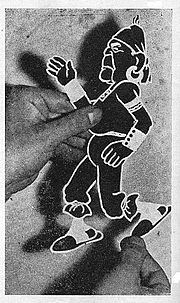
Italian-Argentine cartoonist Quirino Cristiani showing the cut and articulated figure of his satirical character El Peludo (based on President Yrigoyen) patented in 1916 for the realization of his films, including the world's first animated characteristic movie El Apóstol.[6]
In 1917, Italian-Argentine director Quirino Cristiani fabricated the first feature-length moving-picture show El Apóstol (at present lost), which became a critical and commercial success. It was followed by Cristiani'southward Sin dejar rastros in 1918, just one day later on its premiere, the film was confiscated past the government.
Subsequently working on it for three years, Lotte Reiniger released the German feature-length silhouette animation Die Abenteuer des Prinzen Achmed in 1926, the oldest extant animated feature.
In 1937, Walt Disney Studios premiered their showtime animated feature, Snowfall White and the Vii Dwarfs, all the same ane of the highest-grossing traditional animation features every bit of May 2020[update].[7] [eight] The Fleischer studios followed this example in 1939 with Gulliver'southward Travels with some success. Partly due to strange markets existence cutting off by the Second Earth War, Disney'south next features Pinocchio, Fantasia (both 1940) and Fleischer Studios' 2nd blithe feature Mr. Problems Goes to Boondocks (1941–1942) failed at the box office. For decades later, Disney would be the only American studio to regularly produce animated features, until Ralph Bakshi became the first to too release more than than a handful features. Sullivan-Bluth Studios began to regularly produce animated features starting with An American Tail in 1986.
Although relatively few titles became every bit successful equally Disney's features, other countries developed their own animation industries that produced both curt and feature theatrical animations in a wide multifariousness of styles, relatively oft including stop motion and cutout animation techniques. Russia'southward Soyuzmultfilm animation studio, founded in 1936, produced twenty films (including shorts) per year on average and reached ane,582 titles in 2018. China, Czechoslovakia / Czech republic, Italy, France, and Belgium were other countries that more than occasionally released feature films, while Nihon became a true powerhouse of animation production, with its own recognizable and influential anime style of constructive limited animation.
Goggle box [edit]
Blitheness became very popular on television since the 1950s, when television sets started to go common in near adult countries. Cartoons were mainly programmed for children, on convenient fourth dimension slots, and especially United states of america youth spent many hours watching Saturday-morning cartoons. Many classic cartoons found a new life on the small screen and past the end of the 1950s, the production of new animated cartoons started to shift from theatrical releases to Idiot box series. Hanna-Barbera Productions was specially prolific and had huge striking serial, such as The Flintstones (1960–1966) (the first prime time animated series), Scooby-Doo (since 1969) and Belgian co-production The Smurfs (1981–1989). The constraints of American television programming and the demand for an enormous quantity resulted in cheaper and quicker limited animation methods and much more formulaic scripts. Quality dwindled until more daring animation surfaced in the late 1980s and in the early 1990s with hit series such as The Simpsons (since 1989) as part of a "renaissance" of American animation.
While US blithe serial besides spawned successes internationally, many other countries produced their own child-oriented programming, relatively often preferring stop motion and puppetry over cel animation. Japanese anime Goggle box series became very successful internationally since the 1960s, and European producers looking for affordable cel animators relatively often started co-productions with Japanese studios, resulting in hit series such as Barbapapa (The Netherlands/Nihon/French republic 1973–1977), Wickie und dice starken Männer/小さなバイキング ビッケ (Vicky the Viking) (Austria/Frg/Nippon 1974), and The Jungle Book (Italy/Japan 1989).
Switch from cels to computers [edit]
Computer animation was gradually adult since the 1940s. 3D wireframe animation started popping upwardly in the mainstream in the 1970s, with an early (curt) appearance in the sci-fi thriller Futureworld (1976).
The Rescuers Down Under was the first feature movie to be completely created digitally without a photographic camera.[9] It was produced in a way that'southward very similar to traditional cel animation on the Computer Animation Production Organisation (CAPS), developed by The Walt Disney Company in collaboration with Pixar in the late 1980s.
The so-chosen 3D style, more frequently associated with computer animation, has become extremely popular since Pixar's Toy Story (1995), the commencement calculator-animated characteristic in this style.
Most of the cel blitheness studios switched to producing by and large reckoner animated films effectually the 1990s, every bit it proved cheaper and more than assisting. Not only the very popular 3D animation manner was generated with computers, but also most of the films and series with a more traditional hand-crafted appearance, in which the mannerly characteristics of cel blitheness could be emulated with software, while new digital tools helped developing new styles and effects.[10] [xi] [12] [13] [14] [fifteen]
Economic status [edit]
In 2010, the blitheness market was estimated to exist worth circa US$80 billion.[16] By 2020, the value had increased to an estimated US$270 billion.[17] Animated characteristic-length films returned the highest gross margins (around 52%) of all motion-picture show genres between 2004 and 2013.[18] Animation as an art and manufacture continues to thrive as of the early 2020s.
Didactics, propaganda and commercials [edit]
The clarity of animation makes it a powerful tool for instruction, while its total malleability as well allows exaggeration that can be employed to convey potent emotions and to thwart reality. Information technology has therefore been widely used for other purposes than mere amusement.
During Globe State of war Ii, blitheness was widely exploited for propaganda. Many American studios, including Warner Bros. and Disney, lent their talents and their cartoon characters to convey to the public sure war values. Some countries, including China, Nippon and the United kingdom of great britain and northern ireland, produced their first feature-length animation for their war efforts.
Animation has been very popular in television commercials, both due to its graphic appeal, and the humor it tin provide. Some animated characters in commercials have survived for decades, such as Snap, Crackle and Pop in advertisements for Kellogg's cereals.[19] The legendary animation director Tex Avery was the producer of the offset Raid "Kills Bugs Dead" commercials in 1966, which were very successful for the visitor.[20]
Other media, merchandise and theme parks [edit]
Apart from their success in movie theaters and television series, many cartoon characters would likewise prove extremely lucrative when licensed for all kinds of merchandise and for other media.
Animation has traditionally been very closely related to comic books. While many comic book characters institute their way to the screen (which is oftentimes the instance in Japan, where many manga are adapted into anime), original animated characters also commonly appear in comic books and magazines. Somewhat similarly, characters and plots for video games (an interactive animation medium) have been derived from films and vice versa.
Some of the original content produced for the screen tin can exist used and marketed in other media. Stories and images can easily exist adapted into children's books and other printed media. Songs and music have appeared on records and as streaming media.
While very many animation companies commercially exploit their creations outside moving image media, The Walt Disney Company is the best known and near extreme example. Since get-go being licensed for a children's writing tablet in 1929, their Mickey Mouse mascot has been depicted on an enormous amount of products, as have many other Disney characters. This may take influenced some debasing use of Mickey's proper name, just licensed Disney products sell well, and the so-called Disneyana has many gorging collectors, and fifty-fifty a dedicated Disneyana fanclub (since 1984).
Disneyland opened in 1955 and features many attractions that were based on Disney's drawing characters. Its enormous success spawned several other Disney theme parks and resorts. Disney's earnings from the theme parks have relatively ofttimes been higher than those from their movies.
Criticism [edit]
Criticism of animation has been common in media and movie theatre since its inception. With its popularity, a big amount of criticism has arisen, especially blithe feature-length films.[21] Many concerns of cultural representation, psychological furnishings on children have been brought up around the blitheness industry, which has remained rather politically unchanged and brackish since its inception into mainstream culture.[22]
Awards [edit]
As with whatsoever other class of media, animation has instituted awards for excellence in the field. Many are function of general or regional flick accolade programs, like the Red china's Gilt Rooster Award for Best Blitheness (since 1981). Awards programs defended to animation, with many categories, include ASIFA-Hollywood's Annie Awards, the Emile Awards in Europe and the Anima Mundi awards in Brazil.
Academy Awards [edit]
Apart from University Awards for Best Animated Short Flick (since 1932) and Best Animated Feature (since 2002), blithe movies have been nominated and rewarded in other categories, relatively oft for Best Original Song and Best Original Score.
Beauty and the Brute was the get-go animated film nominated for All-time Picture, in 1991. Up (2009) and Toy Story iii (2010) also received Best Picture nominations, after the Academy expanded the number of nominees from 5 to ten.
Production [edit]
The creation of non-trivial animation works (i.e., longer than a few seconds) has developed every bit a grade of filmmaking, with certain unique aspects.[23] Traits common to both alive-action and animated characteristic-length films are labor intensity and high production costs.[24]
The well-nigh important difference is that in one case a picture is in the production phase, the marginal cost of one more shot is higher for animated films than live-action films.[25] It is relatively piece of cake for a manager to ask for i more have during principal photography of a live-action film, simply every take on an animated film must be manually rendered by animators (although the job of rendering slightly dissimilar takes has been made less tedious by modern computer animation).[26] Information technology is pointless for a studio to pay the salaries of dozens of animators to spend weeks creating a visually dazzling five-minute scene if that scene fails to effectively advance the plot of the picture show.[27] Thus, animation studios starting with Disney began the practice in the 1930s of maintaining story departments where storyboard artists develop every single scene through storyboards, then handing the motion-picture show over to the animators but after the product team is satisfied that all the scenes make sense equally a whole.[28] While alive-activeness films are at present also storyboarded, they enjoy more latitude to depart from storyboards (i.e., existent-time improvisation).[29]
Another problem unique to animation is the requirement to maintain a movie'southward consistency from start to finish, even as films have grown longer and teams have grown larger. Animators, like all artists, necessarily accept individual styles, just must subordinate their individuality in a consistent way to whatever style is employed on a particular film.[30] Since the early 1980s, teams of about 500 to 600 people, of whom 50 to 70 are animators, typically have created feature-length animated films. It is relatively easy for two or three artists to match their styles; synchronizing those of dozens of artists is more hard.[31]
This problem is usually solved by having a separate grouping of visual development artists develop an overall await and palette for each film before the animation begins. Character designers on the visual evolution team draw model sheets to show how each grapheme should wait like with different facial expressions, posed in different positions, and viewed from different angles.[32] [33] On traditionally animated projects, maquettes were ofttimes sculpted to farther help the animators see how characters would look from dissimilar angles.[34] [32]
Unlike live-activity films, animated films were traditionally developed beyond the synopsis stage through the storyboard format; the storyboard artists would and so receive credit for writing the movie.[35] In the early 1960s, blitheness studios began hiring professional screenwriters to write screenplays (while also continuing to use story departments) and screenplays had become commonplace for animated films by the late 1980s.
Techniques [edit]
Traditional [edit]

Traditional animation (also called cel animation or paw-drawn animation) was the process used for most animated films of the 20th century.[36] The individual frames of a traditionally animated film are photographs of drawings, first fatigued on paper.[37] To create the illusion of motility, each drawing differs slightly from the one earlier information technology. The animators' drawings are traced or photocopied onto transparent acetate sheets called cels,[38] which are filled in with paints in assigned colors or tones on the side reverse the line drawings.[39] The completed character cels are photographed one-by-one confronting a painted groundwork by a rostrum camera onto move picture film.[twoscore]
The traditional cel blitheness process became obsolete past the beginning of the 21st century. Today, animators' drawings and the backgrounds are either scanned into or drawn directly into a reckoner system.[1] [41] Diverse software programs are used to colour the drawings and simulate photographic camera movement and effects.[42] The last animated piece is output to one of several delivery media, including traditional 35 mm film and newer media with digital video.[43] [1] The "wait" of traditional cel animation is still preserved, and the graphic symbol animators' work has remained essentially the same over the past 70 years.[34] Some blitheness producers take used the term "tradigital" (a play on the words "traditional" and "digital") to describe cel blitheness that uses pregnant reckoner technology.
Examples of traditionally animated feature films include Pinocchio (United States, 1940),[44] Animate being Farm (Britain, 1954), Lucky and Zorba (Italy, 1998), and The Illusionist (British-French, 2010). Traditionally blithe films produced with the aid of computer engineering science include The Lion King (Usa, 1994), The Prince of Egypt (Usa, 1998), Akira (Japan, 1988),[45] Spirited Away (Nihon, 2001), The Triplets of Belleville (France, 2003), and The Secret of Kells (Irish gaelic-French-Belgian, 2009).
Full [edit]
Full animation refers to the process of producing high-quality traditionally animated films that regularly utilize detailed drawings and plausible motion,[46] having a polish animation.[47] Fully animated films can be made in a variety of styles, from more realistically animated works like those produced past the Walt Disney studio (The Picayune Mermaid, Beauty and the Beast, Aladdin, The King of beasts King) to the more 'cartoon' styles of the Warner Bros. animation studio. Many of the Disney blithe features are examples of full animation, as are non-Disney works, The Hugger-mugger of NIMH (United states of america, 1982), The Atomic number 26 Behemothic (US, 1999), and Nocturna (Spain, 2007). Fully blithe films are blithe at 24 frames per 2d, with a combination of blitheness on ones and twos, meaning that drawings can be held for i frame out of 24 or ii frames out of 24.[48]
Express [edit]
Express animation involves the use of less detailed or more stylized drawings and methods of movement normally a choppy or "skippy" movement blitheness.[49] Limited animation uses fewer drawings per second, thereby limiting the fluidity of the animation. This is a more than economic technique. Pioneered by the artists at the American studio United Productions of America,[50] limited animation can be used every bit a method of stylized artistic expression, as in Gerald McBoing-Boing (US, 1951), Yellow Submarine (UK, 1968), and certain anime produced in Japan.[51] Its chief utilize, withal, has been in producing cost-effective animated content for media for television (the work of Hanna-Barbera,[52] Filmation,[53] and other TV animation studios[54]) and after the Internet (web cartoons).
Rotoscoping [edit]
Rotoscoping is a technique patented by Max Fleischer in 1917 where animators trace alive-activeness movement, frame by frame.[55] The source picture show can be directly copied from actors' outlines into animated drawings,[56] as in The Lord of the Rings (US, 1978), or used in a stylized and expressive manner, as in Waking Life (US, 2001) and A Scanner Darkly (U.s., 2006). Some other examples are Fire and Ice (US, 1983), Heavy Metallic (1981), and Aku no Hana (Japan, 2013).
Live-action blending [edit]
Live-action/animation is a technique combining hand-drawn characters into live action shots or alive-activeness actors into animated shots.[57] One of the earlier uses was in Koko the Clown when Koko was drawn over alive-action footage.[58] Walt Disney and Ub Iwerks created a series of Alice Comedies (1923–1927), in which a live-activity girl enters an animated world. Other examples include Allegro Non Troppo (Italia, 1976), Who Framed Roger Rabbit (United states, 1988), Volere volare (Italy 1991), Space Jam (The states, 1996) and Osmosis Jones (US, 2001).
Stop motion [edit]
Finish-movement animation is used to describe animation created by physically manipulating existent-world objects and photographing them one frame of film at a time to create the illusion of motility.[59] In that location are many different types of stop-motion animation, usually named later on the medium used to create the animation.[lx] Computer software is widely available to create this type of animation; traditional cease-move animation is usually less expensive simply more time-consuming to produce than current figurer animation.[sixty]
- Puppet animation
- Typically involves cease-motion puppet figures interacting in a constructed environment, in contrast to real-world interaction in model animation.[61] The puppets generally accept an armature inside of them to keep them still and steady to constrain their motility to particular joints.[62] Examples include The Tale of the Fox (France, 1937), The Nightmare Before Christmas (U.s.a., 1993), Corpse Bride (United states, 2005), Coraline (United states, 2009), the films of Jiří Trnka and the adult animated sketch-one-act television series Robot Chicken (The states, 2005–present).
- Puppetoon
- Created using techniques developed by George Pal,[63] are puppet-animated films that typically utilise a different version of a boob for different frames, rather than simply manipulating one existing puppet.[64]

A dirt animation scene from a Finnish television commercial
- Dirt animation or Plasticine blitheness
- (Oft called claymation, which, however, is a trademarked proper name). It uses figures made of clay or a similar malleable textile to create stop-motion animation.[59] [65] The figures may take an armature or wire frame inside, similar to the related puppet animation (below), that can exist manipulated to pose the figures.[66] Alternatively, the figures may exist made entirely of clay, in the films of Bruce Bickford, where clay creatures morph into a variety of different shapes. Examples of clay-animated works include The Gumby Show (U.s., 1957–1967), Mio Mao (Italy, 1974–2005), Morph shorts (Great britain, 1977–2000), Wallace and Gromit shorts (U.k., as of 1989), Jan Švankmajer's Dimensions of Dialogue (Czechoslovakia, 1982), The Trap Door (UK, 1984). Films include Wallace & Gromit: The Curse of the Were-Rabbit, Craven Run and The Adventures of Mark Twain.[67]
- Strata-cut animation
- Most commonly a class of clay blitheness in which a long bread-like "loaf" of dirt, internally packed tight and loaded with varying imagery, is sliced into thin sheets, with the animation camera taking a frame of the end of the loaf for each cutting, somewhen revealing the movement of the internal images within.[68]
- Cutout animation
- A type of cease-motion animation produced past moving two-dimensional pieces of textile paper or fabric.[69] Examples include Terry Gilliam's animated sequences from Monty Python's Flying Circus (UK, 1969–1974); Fantastic Planet (France/Czechoslovakia, 1973); Tale of Tales (Russian federation, 1979), The pilot episode of the adult tv set sitcom serial (and sometimes in episodes) of S Park (US, 1997) and the music video Live for the moment, from Verona Riots ring (produced by Alberto Serrano and Nívola Uyá, Spain 2014).
- Silhouette animation
- A variant of cutout animation in which the characters are backlit and only visible as silhouettes.[lxx] Examples include The Adventures of Prince Achmed (Weimar Republic, 1926) and Princes et Princesses (France, 2000).
- Model animation
- Refers to stop-motility animation created to interact with and exist as a part of a live-activity earth.[71] Intercutting, matte effects and separate screens are ofttimes employed to blend terminate-movement characters or objects with alive actors and settings.[72] Examples include the work of Ray Harryhausen, as seen in films, Jason and the Argonauts (1963),[73] and the work of Willis H. O'Brien on films, King Kong (1933).
- Become motility
- A variant of model animation that uses various techniques to create motion blur between frames of pic, which is not present in traditional cease movement.[74] The technique was invented by Industrial Light & Magic and Phil Tippett to create special effect scenes for the film The Empire Strikes Dorsum (1980).[75] Another case is the dragon named "Vermithrax" from the 1981 film Dragonslayer.[76]
- Object animation
- Refers to the use of regular inanimate objects in terminate-movement blitheness, as opposed to specially created items.[77]
- Graphic blitheness
- Uses non-fatigued flat visual graphic fabric (photographs, newspaper clippings, magazines, etc.), which are sometimes manipulated frame by frame to create move.[78] At other times, the graphics remain stationary, while the end-move camera is moved to create on-screen activeness.
- Brickfilm
- A subgenre of object animation involving using Lego or other like brick toys to brand an animation.[79] [fourscore] These have had a recent heave in popularity with the appearance of video sharing sites, YouTube and the availability of cheap cameras and animation software.[81]
- Pixilation
- Involves the employ of live humans equally stop-motion characters.[82] This allows for a number of surreal effects, including disappearances and reappearances, allowing people to announced to slide across the footing, and other effects.[82] Examples of pixilation include The Secret Adventures of Tom Thumb and Angry Kid shorts, and the Academy Award-winning Neighbours past Norman McLaren.
Computer [edit]
Computer animation encompasses a variety of techniques, the unifying gene being that the animation is created digitally on a computer.[42] [83] 2D animation techniques tend to focus on prototype manipulation while 3D techniques ordinarily build virtual worlds in which characters and objects movement and collaborate.[84] 3D animation tin can create images that seem real to the viewer.[85]
2D [edit]

A 2d animation of 2 circles joined by a chain
2d animation figures are created or edited on the calculator using second bitmap graphics and 2D vector graphics.[86] This includes automated computerized versions of traditional animation techniques, interpolated morphing,[87] onion skinning[88] and interpolated rotoscoping. second blitheness has many applications, including analog calculator animation, Flash animation, and PowerPoint animation. Cinemagraphs are nevertheless photographs in the form of an blithe GIF file of which part is animated.[89]
Final line advection blitheness is a technique used in second animation,[xc] to give artists and animators more influence and control over the last product as everything is washed within the same department.[91] Speaking about using this approach in Paperman, John Kahrs said that "Our animators can change things, really erase away the CG underlayer if they desire, and change the profile of the arm."[92]
3D [edit]
3D blitheness is digitally modeled and manipulated past an animator. The 3D model maker commonly starts by creating a 3D polygon mesh for the animator to dispense.[93] A mesh typically includes many vertices that are connected past edges and faces, which give the visual appearance of form to a 3D object or 3D environment.[93] Sometimes, the mesh is given an internal digital skeletal structure called an armature that can be used to command the mesh by weighting the vertices.[94] [95] This process is chosen rigging and can exist used in conjunction with key frames to create movement.[96]
Other techniques can be practical, mathematical functions (e.g., gravity, particle simulations), simulated fur or hair, and effects, fire and water simulations.[97] These techniques fall under the category of 3D dynamics.[98]
Terms [edit]
- Cel-shaded blitheness is used to mimic traditional blitheness using calculator software.[99] The shading looks stark, with less blending of colors. Examples include Skyland (2007, French republic), The Fe Giant (1999, U.s.a.), Futurama (1999, United States) Appleseed Ex Machina (2007, Japan), The Legend of Zelda: The Wind Waker (2002, Nippon), The Legend of Zelda: Breath of the Wild (2017, Japan)
- Machinima – Films created by screen capturing in video games and virtual worlds. The term originated from the software introduction in the 1980s demoscene, as well as the 1990s recordings of the first-person shooter video game Quake.
- Motion capture is used when live-activity actors wear special suits that allow computers to copy their movements into CG characters.[100] [101] Examples include Polar Express (2004, US), Beowulf (2007, United states), A Christmas Carol (2009, US), The Adventures of Tintin (2011, U.s.) kochadiiyan (2014, India)
- Computer animation is used primarily for animation that attempts to resemble existent life, using advanced rendering that mimics in particular skin, plants, water, fire, clouds, etc.[102] Examples include Up (2009, The states), How to Railroad train Your Dragon (2010, US)
- Physically based blitheness is animation using computer simulations.[103]
Mechanical [edit]
- Animatronics is the use of mechatronics to create machines that seem animate rather than robotic.
- Audio-Animatronics and Autonomatronics is a form of robotics animation, combined with iii-D animation, created past Walt Disney Imagineering for shows and attractions at Disney theme parks move and make noise (by and large a recorded speech or song).[104] They are fixed to whatsoever supports them. They can sit and stand, and they cannot walk. An Audio-Animatron is different from an android-type robot in that it uses prerecorded movements and sounds, rather than responding to external stimuli. In 2009, Disney created an interactive version of the engineering called Autonomatronics.[105]
- Linear Animation Generator is a form of animation by using static motion-picture show frames installed in a tunnel or a shaft. The animation illusion is created by putting the viewer in a linear move, parallel to the installed picture frames.[106] The concept and the technical solution were invented in 2007 by Mihai Girlovan in Romania.
- Chuckimation is a type of animation created by the makers of the television series Action League Now! in which characters/props are thrown, or chucked from off camera or wiggled around to simulate talking by unseen easily.[107]
- The magic lantern used mechanical slides to project moving images, probably since Christiaan Huygens invented this early on image projector in 1659.
Other [edit]
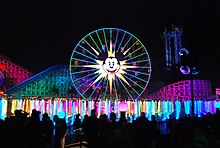
- Hydrotechnics: a technique that includes lights, h2o, burn, fog, and lasers, with loftier-definition projections on mist screens.
- Fatigued on film animation: a technique where footage is produced by creating the images direct on film stock; for example, by Norman McLaren,[108] Len Lye and Stan Brakhage.
- Paint-on-glass animation: a technique for making animated films past manipulating boring drying oil paints on sheets of glass,[109] for example by Aleksandr Petrov.
- Erasure animation: a technique using traditional 2d media, photographed over time as the artist manipulates the epitome. For example, William Kentridge is famous for his charcoal erasure films,[110] and Piotr Dumała for his auteur technique of animative scratches on plaster.
- Pinscreen animation: makes employ of a screen filled with movable pins that can exist moved in or out by pressing an object onto the screen.[111] The screen is lit from the side then that the pins cast shadows. The technique has been used to create animated films with a range of textural effects difficult to reach with traditional cel animation.[112]
- Sand blitheness: sand is moved around on a back- or front-lighted piece of glass to create each frame for an animated film.[113] This creates an interesting effect when blithe because of the calorie-free contrast.[114]
- Flip book: a flip book (sometimes, specially in British English, called a flick book) is a book with a series of pictures that vary gradually from one page to the adjacent, so that when the pages are turned chop-chop, the pictures appear to animate by simulating movement or some other modify.[115] [116] Flip books are often illustrated books for children,[117] they also are geared towards adults and use a series of photographs rather than drawings. Flip books are non always carve up books, they announced as an added feature in ordinary books or magazines, oft in the page corners.[115] Software packages and websites are besides available that convert digital video files into custom-fabricated flip books.[118]
- Graphic symbol animation
- Multi-sketching
- Special effects blitheness
Run into also [edit]
- Twelve basic principles of blitheness
- Animated war film
- Blitheness department
- Animated series
- Architectural blitheness
- Avar
- Independent blitheness
- International Blitheness Day
- International Blithe Film Association
- International Tournée of Animation
- List of film-related topics
- Movement graphic pattern
- Club for Animation Studies
- Wire-frame model
References [edit]
Citations [edit]
- ^ a b c Buchan 2013.
- ^ "The definition of animation on dictionary.com".
- ^ Solomon 1989, p. 28.
- ^ Solomon 1989, p. 24.
- ^ Solomon 1989, p. 34.
- ^ Bendazzi 1994, p. 49.
- ^ * Full prior to 50th ceremony reissue: Culhane, John (12 July 1987). "'Snowfall White' At 50: Undimmed Magic". The New York Times. Archived from the original on 4 June 2014. Retrieved 29 June 2014.
Past at present, it has grossed nearly $330 million worldwide - so it remains one of the near pop films e'er fabricated.
- ^ * 1987 and 1993 grosses from Due north America: "Snow White and the Seven Dwarfs – Releases". Box Role Mojo. Archived from the original on 29 May 2014. Retrieved 29 June 2014.
1987 release – $46,594,212; 1993 release – $41,634,471
- ^ "First fully digital feature pic". Guinness World Records. Guinness World Records Express. Retrieved 27 December 2018.
- ^ Amidi, Amidst (1 June 2015). "Sergio Pablos Talks Virtually His Stunning Paw-Drawn Project 'Klaus'". Cartoon Brew . Retrieved 12 October 2019.
- ^ "The Origins of Klaus". YouTube. x October 2019. Archived from the original on 22 November 2021. Retrieved 12 Oct 2019.
- ^ Bernstein, Abbie (25 February 2013). "Assignment Ten". Sectional Interview: John Kahrs & Kristina Reed on PAPERMAN. Midnight Productions, Inc. Retrieved vi October 2013.
- ^ "Beginning LOOK: Disney's 'Paperman' fuses manus-drawn amuse with digital depth". EW.com . Retrieved 2 October 2014.
- ^ Sarto, Dan. "Inside Disney's New Blithe Short Paperman". Animation World Network. Retrieved five June 2012.
- ^ "Disney's Paperman animated brusque fuses CG and hand-drawn techniques". Retrieved two October 2014.
- ^ Board of Investments 2009.
- ^ "Global blitheness market value 2017-2020". Statista . Retrieved 31 March 2022.
- ^ McDuling 2014.
- ^ "Snap, Crackle, Pop® | Rice Krispies®". world wide web.ricekrispies.com . Retrieved 16 June 2020.
- ^ Taylor, Heather (10 June 2019). "The Raid Bugs: Characters We Dearest To Hate". PopIcon.life . Retrieved sixteen June 2020.
- ^ Amidi 2011.
- ^ Nagel 2008.
- ^ Laybourne 1998, p. 117.
- ^ Solomon 1989, p. 274.
- ^ White 2006, p. 151.
- ^ Laybourne 1998, p. 339.
- ^ Culhane 1990, p. 55.
- ^ Solomon 1989, p. 120.
- ^ Laybourne 1998, pp. 100–01.
- ^ Masson 2007, p. 94.
- ^ Beck 2004, p. 37.
- ^ a b Williams 2001, p. 34.
- ^ Culhane 1990, p. 146.
- ^ a b Williams 2001, pp. 52–57.
- ^ Laybourne 1998, pp. 99–100.
- ^ White 2006, p. 31.
- ^ Beckerman 2003, p. 153.
- ^ Thomas & Johnston 1981, pp. 277–79.
- ^ Laybourne 1998, p. 203.
- ^ White 2006, pp. 195–201.
- ^ White 2006, p. 394.
- ^ a b Culhane 1990, p. 296.
- ^ Laybourne 1998, pp. 35–36, 52–53.
- ^ Solomon 1989, pp. 63–65.
- ^ Beckerman 2003, p. lxxx.
- ^ Culhane 1990, p. 71.
- ^ Culhane 1990, pp. 194–95.
- ^ Laybourne 1998, pp. 25–26.
- ^ Beckerman 2003, p. 142.
- ^ Beckerman 2003, pp. 54–55.
- ^ Ledoux 1997, p. 24, 29.
- ^ Lawson & Persons 2004, p. 82.
- ^ Solomon 1989, p. 241.
- ^ Lawson & Persons 2004, p. xxi.
- ^ Crafton 1993, p. 158.
- ^ Laybourne 1998, pp. 163–64.
- ^ Laybourne 1998, pp. 162–63.
- ^ Beck 2004, pp. 18–xix.
- ^ a b Solomon 1989, p. 299.
- ^ a b Laybourne 1998, p. 159.
- ^ Solomon 1989, p. 171.
- ^ Laybourne 1998, pp. 155–56.
- ^ Brook 2004, p. seventy.
- ^ Beck 2004, pp. 92–93.
- ^ Laybourne 1998, pp. 150–151.
- ^ Laybourne 1998, pp. 151–54.
- ^ Beck 2004, p. 250.
- ^ Furniss 1998, pp. 52–54.
- ^ Laybourne 1998, pp. 59–60.
- ^ Culhane 1990, pp. 170–171.
- ^ Harryhausen & Dalton 2008, pp. 9–11.
- ^ Harryhausen & Dalton 2008, pp. 222–26
- ^ Harryhausen & Dalton 2008, p. 18
- ^ Smith 1986, p. ninety.
- ^ Watercutter 2012.
- ^ Smith 1986, pp. 91–95.
- ^ Laybourne 1998, pp. 51–57.
- ^ Laybourne 1998, p. 128.
- ^ Paul 2005, pp. 357–63.
- ^ Herman 2014.
- ^ Haglund 2014.
- ^ a b Laybourne 1998, pp. 75–79.
- ^ Serenko 2007.
- ^ Masson 2007, p. 405.
- ^ Serenko 2007, p. 482.
- ^ Masson 2007, p. 165.
- ^ Sito 2013, pp. 32, seventy, 132.
- ^ Priebe 2006, pp. 71–72.
- ^ White 2006, p. 392.
- ^ Lowe & Schnotz 2008, pp. 246–47.
- ^ Masson 2007, pp. 127–28.
- ^ Beck 2012.
- ^ a b Masson 2007, p. 88.
- ^ Sito 2013, p. 208.
- ^ Masson 2007, pp. 78–eighty.
- ^ Sito 2013, p. 285.
- ^ Masson 2007, p. 96.
- ^ Lowe & Schnotz 2008, p. 92.
- ^ "Cel Shading: the Unsung Hero of Animation?". Animator Mag. 17 December 2011. Archived from the original on v March 2016. Retrieved 20 February 2016.
- ^ Sito 2013, pp. 207–08.
- ^ Masson 2007, p. 204.
- ^ Parent 2007, p. xix.
- ^ Donald H. House; John C. Keyser (xxx Nov 2016). Foundations of Physically Based Modeling and Blitheness. CRC Press. ISBN978-i-315-35581-8.
- ^ Pilling 1997, p. 249.
- ^ O'Keefe 2014.
- ^ Parent 2007, pp. 22–23.
- ^ Kenyon 1998.
- ^ Faber & Walters 2004, p. 1979.
- ^ Pilling 1997, p. 222.
- ^ Carbone 2010.
- ^ Neupert 2011.
- ^ Pilling 1997, p. 204.
- ^ Chocolate-brown 2003, p. 7.
- ^ Furniss 1998, pp. 30–33.
- ^ a b Laybourne 1998, pp. 22–24.
- ^ Solomon 1989, pp. 8–10.
- ^ Laybourne 1998, p. xiv.
- ^ White 2006, p. 203.
Sources [edit]
Journal articles [edit]
- Anderson, Joseph and Barbara (Spring 1993). "Periodical of Movie and Video". The Myth of Persistence of Vision Revisited. 45 (1): iii–13. Archived from the original on 24 Nov 2009.
- Serenko, Alexander (2007). "Computers in Human Behavior" (PDF). The Development of an Musical instrument to Mensurate the Degree of Blitheness Predisposition of Agent Users. 23 (1): 478–95.
Books [edit]
- Baer, Eva (1983). Metalwork in Medieval Islamic Art. State University of New York Press. pp. 58, 86, 143, 151, 176, 201, 226, 243, 292, 304. ISBN978-0-87395-602-four.
- Beck, Jerry (2004). Blitheness Art: From Pencil to Pixel, the History of Drawing, Anime & CGI. Fulhamm London: Flame Tree Publishing. ISBN978-1-84451-140-2.
- Beckerman, Howard (2003). Animation: The Whole Story. Allworth Press. ISBN978-ane-58115-301-9.
- Bendazzi, Giannalberto (1994). Cartoons: One Hundred Years of Movie house Animation . Bloomington, Indiana: Indiana University Press. ISBN978-0-253-20937-5.
- Buchan, Suzanne (2013). Pervasive Animation. New York and London: Routledge. ISBN978-0-415-80723-4.
- Canemaker, John (2005). Winsor McCay: His Life and Art (Revised ed.). Abrams Books. ISBN978-0-8109-5941-five.
- Cotte, Olivier (2007). Secrets of Oscar-winning Animation: Behind the scenes of xiii classic short animations. Focal Press. ISBN978-0240520704.
- Crafton, Donald (1993). Earlier Mickey: The Animated Film 1898–1928. Chicago: University of Chicago Press. ISBN978-0-226-11667-9.
- Culhane, Shamus (1990). Animation: Script to Screen. St. Martin's Press. ISBN978-0-312-05052-eight.
- Drazin, Charles (2011). The Faber Book of French Movie theatre . Faber & Faber. ISBN978-0-571-21849-3.
- Faber, Liz; Walters, Helen (2004). Animation Unlimited: Innovative Short Films Since 1940 . London: Laurence Rex Publishing. ISBN978-1-85669-346-two.
- Finkielman, Jorge (2004). The Pic Industry in Argentine republic: An Illustrated Cultural History. Northward Carolina: McFarland. p. 20. ISBN978-0-7864-1628-8.
- Furniss, Maureen (1998). Art in Motion: Animation Aesthetics. Indiana University Press. ISBN978-one-86462-039-9.
- Godfrey, Bob; Jackson, Anna (1974). The Do-Information technology-Yourself Picture show Animation Book. BBC Publications. ISBN978-0-563-10829-0.
- Harryhausen, Ray; Dalton, Tony (2008). A Century of Model Animation: From Méliès to Aardman. Aurum Press. ISBN978-0-8230-9980-1.
- Herman, Sarah (2014). Brick Flicks: A Comprehensive Guide to Making Your Ain Stop-Motion LEGO Movies. New York: Skyhorse Publishing. ISBN978-1-62914-649-ii.
- Lawson, Tim; Persons, Alisa (2004). The Magic Behind the Voices [A Who'south Who of Cartoon Voice Actors]. University Press of Mississippi. ISBN978-i-57806-696-4.
- Laybourne, Kit (1998). The Blitheness Book: A Complete Guide to Animated Filmmaking – from Flip-books to Sound Cartoons to iii-D Blitheness. New York: 3 Rivers Press. ISBN978-0-517-88602-1.
- Ledoux, Trish (1997). Complete Anime Guide: Japanese Animation Film Directory and Resources Guide. Tiger Mountain Press. ISBN978-0-9649542-5-0.
- Lowe, Richard; Schnotz, Wolfgang, eds. (2008). Learning with Blitheness. Enquiry implications for design. New York: Cambridge University Printing. ISBN978-0-521-85189-3.
- Masson, Terrence (2007). CG101: A Computer Graphics Manufacture Reference. Unique and personal histories of early computer blitheness product, plus a comprehensive foundation of the manufacture for all reading levels. Williamstown, MA: Digital Fauxtography. ISBN978-0-9778710-0-1.
- Needham, Joseph (1962). "Science and Civilization in Red china". Physics and Concrete Technology. Vol. IV. Cambridge University Printing.
- Neupert, Richard (2011). French Animation History. John Wiley & Sons. ISBN978-1-4443-3836-ii.
- Parent, Rick (2007). Figurer Animation: Algorithms & Techniques. Ohio State University: Morgan Kaufmann. ISBN978-0-12-532000-9.
- Paul, Joshua (2005). Digital Video Hacks. O'Reilly Media. ISBN978-0-596-00946-5.
- Pilling, Jayne (1997). Society of Animation Studies (ed.). A Reader in Blitheness Studies. Indiana Academy Printing. ISBN978-i-86462-000-nine.
- Priebe, Ken A. (2006). The Art of Finish-Motion Blitheness. Thompson Course Applied science. ISBN978-1-59863-244-half-dozen.
- Rojas, Carlos; Chow, Eileen (2013). The Oxford Handbook of Chinese Cinemas. Oxford University Press. ISBN978-0-19-998844-0.
- Sammond, Nicholas (27 Baronial 2015). Nativity of an Industry: Blackface Minstrelsy and the Rise of American Animation. Durham, NC: Duke University Press. doi:10.1515/9780822375784. ISBN9780822358527. OCLC 8605897837.
- Shaffer, Joshua C. (2010). Discovering The Magic Kingdom: An Unofficial Disneyland Vacation Guide. Indiana: Writer Firm. ISBN978-ane-4520-6312-6.
- Sito, Tom (2013). Moving Innovation: A History of Reckoner Animation. Massachusetts: MIT Press. ISBN978-0-262-01909-5.
- Solomon, Charles (1989). Enchanted Drawings: The History of Animation. New York: Random Business firm, Inc. ISBN978-0-394-54684-1.
- Thomas, Bob (1958). Walt Disney, the Fine art of Blitheness: The Story of the Disney Studio Contribution to a New Fine art. Walt Disney Studios. Simon and Schuster.
- Thomas, Frank; Johnston, Ollie (1981). Disney Animation: The Illusion of Life. Abbeville Press. ISBN978-0-89659-233-9.
- Smith, Thomas G. (1986). Industrial Calorie-free & Magic: The Art of Special Furnishings. New York: Ballantine Books. ISBN978-0-345-32263-0.
- White, Tony (2006). Animation from Pencils to Pixels: Classical Techniques for the Digital Animator. Milton Park: Taylor & Francis. ISBN978-0-240-80670-9.
- Williams, Richard (2001). The Animator'south Survival Kit. Faber and Faber. ISBN978-0-571-20228-7.
- Zielinski, Siegfried (1999). Audiovisions: Movie theatre and Telly as Entr'actes in History. Amsterdam University Printing. ISBN978-xc-5356-303-8.
Online sources [edit]
- Amidi, Amid (2 December 2011). "NY Picture show Critics Didn't like a Single Animated Movie This Year". Cartoon Brew. Retrieved 19 Feb 2016.
- Ball, Ryan (12 March 2008). "Oldest Blitheness Discovered in Iran". Animation Magazine . Retrieved fifteen March 2016.
- Beck, Jerry (two July 2012). "A Petty More than About Disney'southward "Paperman"". Cartoon Mash.
- Bendazzi, Giannalberto (1996). "The Untold Story of Argentine republic's Pioneer Animator". Blitheness World Network. Retrieved 29 Apr 2016.
- "Animation" (PDF). boi.gov.ph. Board of Investments. Nov 2009. Archived from the original (PDF) on 19 October 2012. Retrieved 24 July 2012.
- Brown, Margery (2003). "Experimental Animation Techniques" (PDF). Olympia, WA: Evergreen State Collage. Archived from the original (PDF) on 7 March 2008. Retrieved 11 November 2005.
- Carbone, Ken (24 February 2010). "Stone-Age Animation in a Digital Globe: William Kentridge at MoMA". Fast Company . Retrieved vii March 2016.
- Haglund, David (vii February 2014). "The Oldest Known LEGO Movie". Slate . Retrieved 25 February 2016.
- "Earth's Oldest Animation?". theheritagetrust.wordpress.com. The Heritage Trust. 25 July 2012. Archived from the original on 22 October 2015.
- Kenyon, Heather (1 February 1998). "How'd They Do That?: Stop-Motion Secrets Revealed". Animation World Network. Retrieved 2 March 2016.
- Nagel, Jan (21 May 2008). "Gender in Media: Females Don't Dominion". Blitheness World Network. Retrieved 3 March 2016.
- McDuling, John (iii July 2014). "Hollywood Is Giving Up on Comedy". The Atlantic. The Atlantic Monthly Group. Retrieved twenty July 2014.
- McLaughlin, Dan (2001). "A Rather Incomplete But Nonetheless Fascinating". Film Idiot box. UCLA. Archived from the original on 19 Nov 2009. Retrieved 12 February 2013.
- O'Keefe, Matt (xi November 2014). "six Major Innovations That Sprung from the Heads of Disney Imagineers". Theme Park Tourist. Retrieved 9 March 2016.
- Watercutter, Angela (24 May 2012). "35 Years After Star Wars, Effects Whiz Phil Tippett Is Slowly Crafting a Mad God". Wired . Retrieved 6 February 2016.
- Zohn, Patricia (28 Feb 2010). "Coloring the Kingdom". Vanity Fair . Retrieved vii December 2015.
- "Walt Disney'south Oscars". The Walt Disney Family Museum. 22 February 2013. Archived from the original on 22 March 2015. Retrieved 22 February 2016.
- "Władysław Starewicz – Biography". culture.pl. Adam Mickiewicz Institute. 16 April 2012. Retrieved 9 February 2016.
External links [edit]
- The making of an 8-minute cartoon curt
- "Animando", a 12-infinitesimal film demonstrating x different blitheness techniques (and educational activity how to employ them).
- Bibliography on animation – Websiite "Histoire de la télévision"
- Animation at Curlie
shackelforddreptur.blogspot.com
Source: https://en.wikipedia.org/wiki/Animation
0 Response to "Rtf 351c Introduction to 2d Animation Aet 325 Digital Production Art 2d"
Post a Comment