How to Ask Client What Rate Theyã¢â‚¬â„¢re Willing to Pay
How to Boost Sales by Downward-Selling Your Customers
Lots of businesses have mastered the up-sell. You take a common product and give information technology premium characteristics with a higher toll tag to match. Think of what Starbucks has done to the fifty-cent cup of coffee.
In this economy, the down-sell might be a better move. Consumers may exist spending over again, but they're doing so cautiously and with a newfound resolve to stick to a upkeep. If they're giving up the bells and whistles in favor of more basic and affordable products, why non follow conform and have the "premium" out of your premium products?
It'due south a much trickier proffer — that'south why. If you go too cheap, yous risk, among other dangers, killing your profit margins and diluting your brand. Even the usually savvy marketer Martha Stewart learned this the hard way. She recently yanked her low-finish Martha Stewart Everyday line of houseware items from Kmart. What was once a lucrative revenue stream for her company had become, she argued, a low-quality brand that was tarnishing her good proper noun. "Martha Stewart has never been able to go back up to premium since Kmart," says Donald Mazzella, COO of Data Strategies Inc., a New Bailiwick of jersey-based small-business consultancy. "She is a commodity now."
Simply hang on a 2nd. You're non Martha Stewart, and y'all're probably not dealing with the same economies of scale. Marketing experts say smaller businesses are meliorate positioned to experiment with new products and new pricing more easily, and to respond more speedily to customers' feedback. If you tin can't sell your premium product, there's no shame in pushing low-end items to proceed sales up. Just make certain that by going inexpensive, you don't cheapen your brand. Here are three things to keep in mind.
Give Customers Something New
You lot could simplify an existing product past stripping it down to its essentials, or employ this economic system as an opportunity to invent a completely new, cheaper production. If yous're going to try to exercise the latter, says George T. Haley, a marketing professor at the University of New Haven, get to your customers for clues about what they're looking for and what they're willing to buy. But brand certain you don't requite them exactly what they say they desire — your customers probably only know what'southward already out there. It'south your job to figure out what's new.
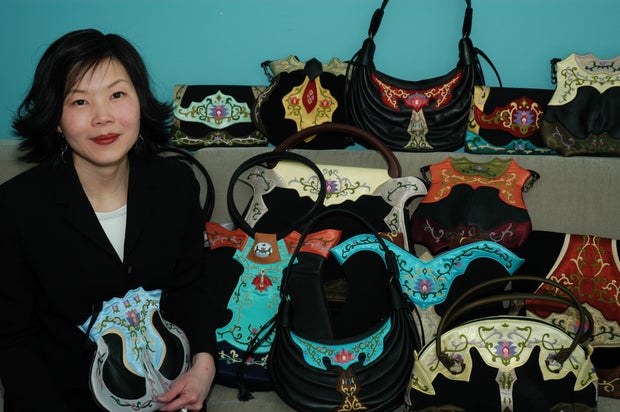
Oovoo Designs founder Pauline Lewis launched a line of $35 cell-telephone holders during the recession.
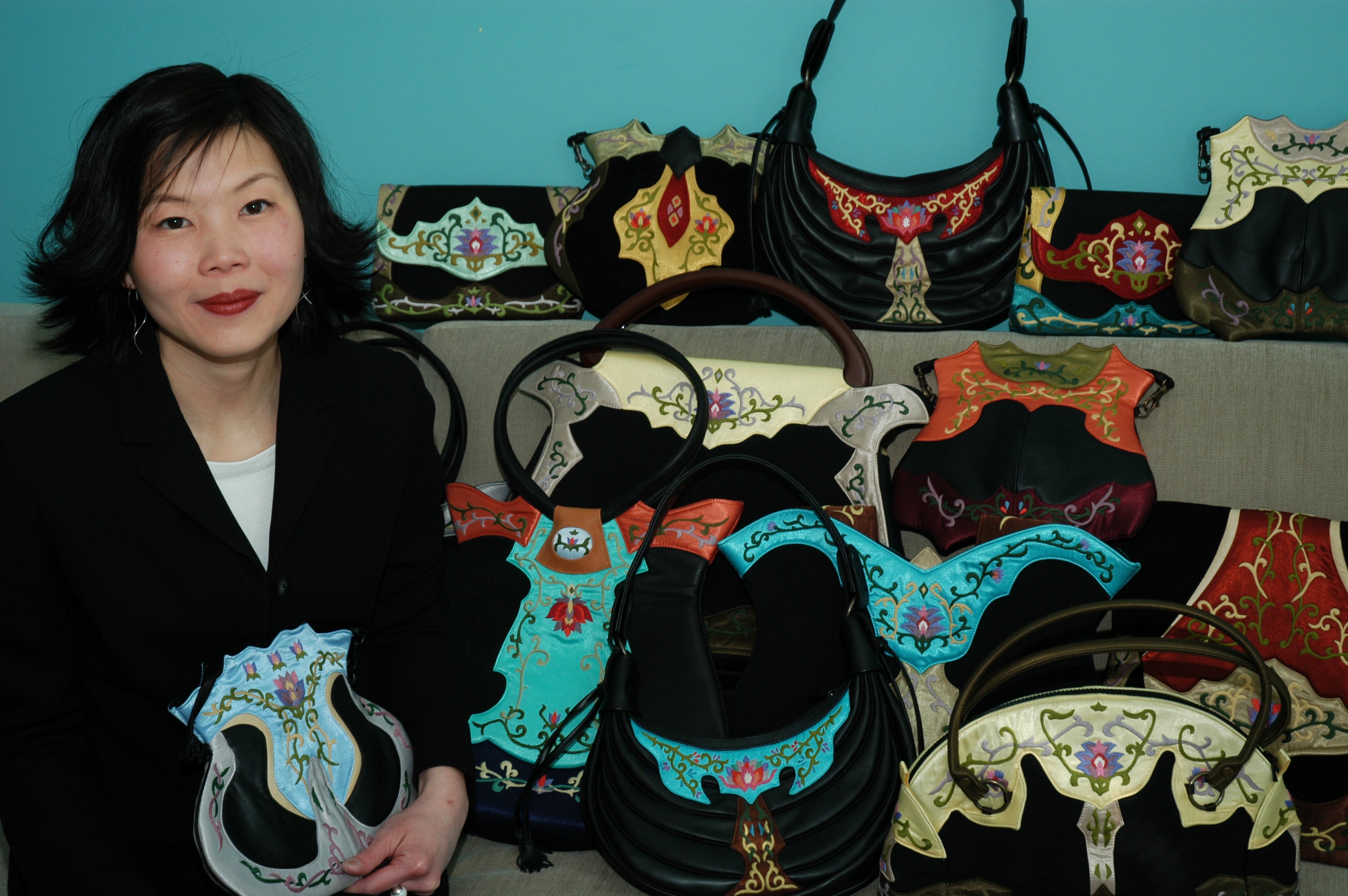
Take bag company Oovoo Designs in Alexandria, Va. In 2008, Pauline Lewis, founder of the $500,000 company, saw sales slipping virtually 15 per centum for her high-end numberless, which are mitt-stitched and embroidered in Vietnam, and sell for about $250 at boutiques. She also watched as customers picked up her cheapest production, a clutch bag for $99, and said they wished they could buy it, but couldn't afford it now. So Lewis took immediate action. She talked to buyers at retail and wholesale trade shows and went to the boutiques selling her bags to ask customers what kind of items they needed and wanted. "First and foremost, I did non want to dilute my brand," by just slashing prices, she says.
From her enquiry she came away with a new idea: a line of $35 cell-phone holders with some of the same hand-embroidered flourishes equally the pricier items. Cell phones are indispensable for virtually women, something they reach for about six times a twenty-four hours, says Lewis. Moreover, the new product would skew slightly younger than the 35-and-over crowd that gravitated to her handbags. "Younger women tin can't afford the $250 pocketbook, but they love the brand so much, and they volition aspire to earn or salve enough to get my bigger Oovoo pocketbook," she adds.
The strategy ultimately offset losses for the more up-market place bags. She sold about 1,500 of the cell-phone holders in 2008, and and so about 2,500 the post-obit yr.
Pitch the Value
Marketing non-premium products in a downwardly economy requires a unlike kind of sales pitch. "You accept to piece of work at helping people sympathize the value deviation," says Larry W. Cox, acquaintance professor of entrepreneurship at Pepperdine Academy'south business school. Yous need to convey that they are still getting a valuable product, merely it's priced for the recession, and they "would be crazy non to take that offer," says Cox. That mode, customers become the message that you are looking out for their needs and you are still providing the high quality that they associate with your brand.
Lewis is subtly working that bulletin into her new production release this yr. Though she has no intention of discontinuing her cell-phone holder because she has successfully tapped a new market place, she'southward thinking well-nigh next steps. In 2010, she'll push a slightly more expensive production — a casual tote priced at $60. "Every bit the economic system starts to pick upwards, the $99 item is not something people will necessarily buy, but they are ready to upgrade to a $sixty item," she says. The message is about "communicating to my clients that things are getting better and we would like to offering you something a petty bigger, amend, and brighter."
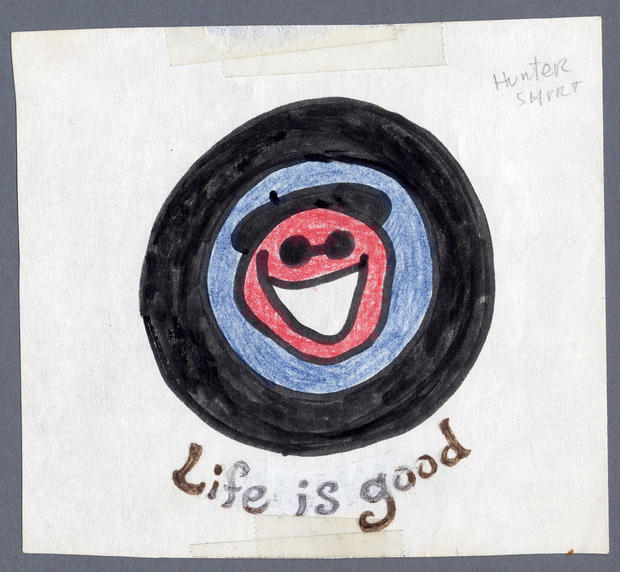
The original Life Is Skillful logo.
Life Is Skilful, the Boston-based apparel company, learned early that the marketing message makes all difference, specially when the non-premium product is already a commodity in the marketplace. Brothers John and Bert Jacobs started selling sports-themed and artsy t-shirts out of the dorsum of their truck in 1989. For 5 years, business was pretty modest. Then, fed up with what they perceived to be a perpetually negative mood in the country, the Jacobs decided Americans needed more than optimism — via t-shirts. They came upwardly with "Jake," a smile stick figure, and put him on a shirt along with the phrase, "Life Is Good." On the first twenty-four hours, they sold fifty shirts in the kickoff 45 minutes to anybody from skate punks and schoolmarms to hardcore Harley Davidson fans. "Our strategy is to be inclusive, not sectional, with the message," says Bert Jacobs, CEO of the $100 1000000 company. At $30 a shirt, the price isn't sectional either, although Jacobs says at present the visitor tin can go the other direction and upwardly-sell customers with a premium $60 production.
Know Your Brand
Downwardly-selling customers won't piece of work for every company, peculiarly if the brand image depends on an air of loftier-end exclusivity to differentiate it from competitors. Hangar 1 Vodka, for example, which BNET featured in a contempo video, says that moving downward-market place would shatter its $ix million business organisation, which rests on presenting its $39 vodka every bit an artisanal product. Hangar 1 justifies the premium toll point by touting the all-natural ingredients and the made-past-paw manufacturing process. Plus, the visitor can continue to accuse more, in part, because vodka falls into a lifestyle category where people are willing to pay based on perception of the product. "I will ofttimes purchase a more expensive product even when it functionally does the aforementioned matter as a cheaper i, if it is a brand I take more confidence in," explains Pepperdine'southward Cox.
While sales in 2009 vicious about 17 percentage for the Ukiah, Calif.-based company, sales were downwardly nigh 40 percentage for Hangar one'due south competitors, co-ordinate to co-founder Ansley Coale. He says he has no intention of going downwardly-marketplace, ever. "Nobody stopped drinking Starbucks," he says. "They're merely not drinking as a much."
Thank you for reading CBS NEWS.
Create your free business relationship or log in
for more features.
shackelforddreptur.blogspot.com
Source: https://www.cbsnews.com/news/how-to-boost-sales-by-down-selling-your-customers/
0 Response to "How to Ask Client What Rate Theyã¢â‚¬â„¢re Willing to Pay"
Post a Comment